Assurance disciplines
The assurance disciplines test the explanation the architecture layers give. Each one asks a question of every layer: is the need captured, can use go wrong, what could cause harm, what could an attacker do, and how do we know.
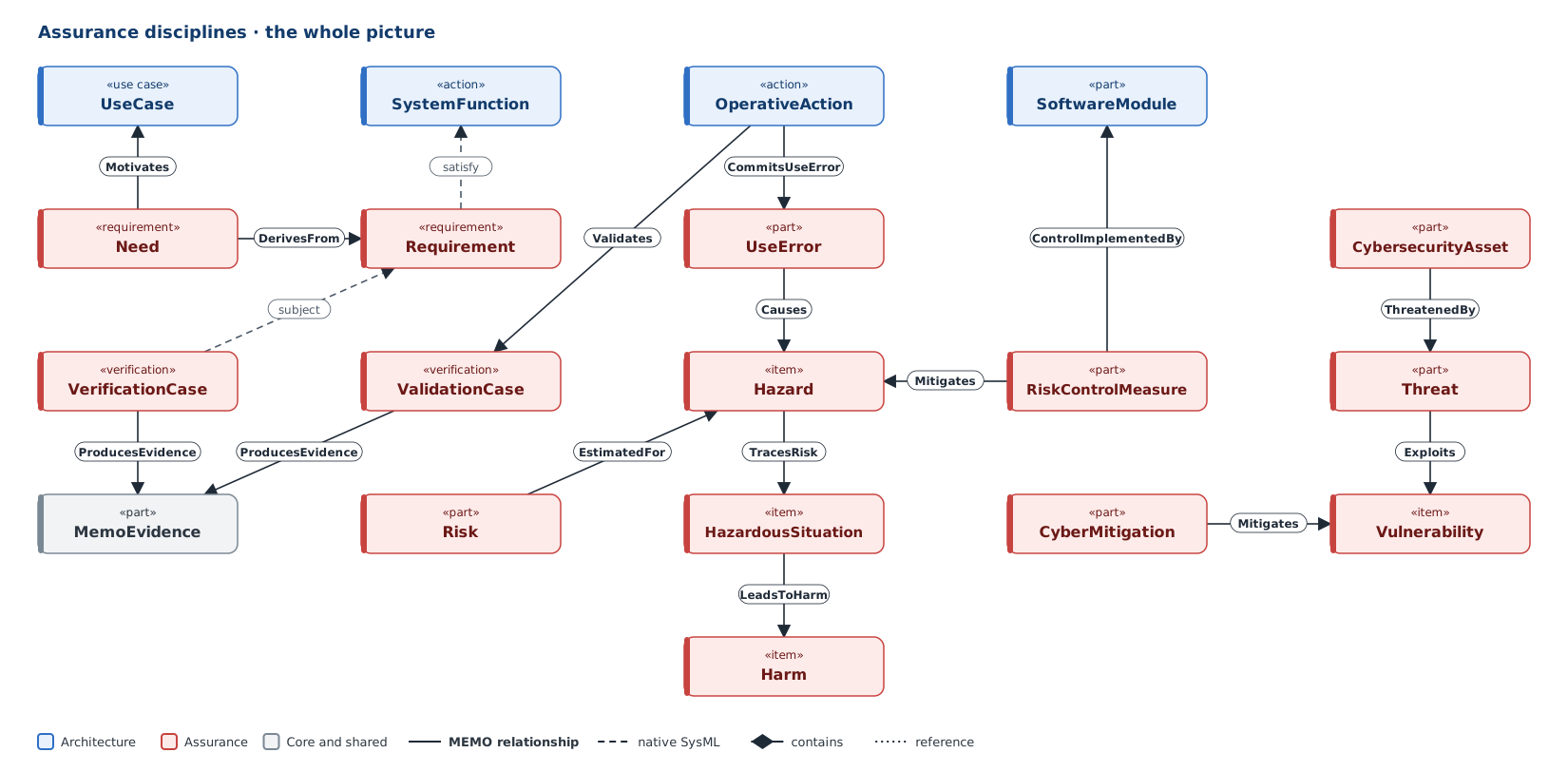
The blue boxes along the top are architecture elements, the red ones are assurance, and the grey evidence record comes from Core. Colours and line styles follow the key.
Building it up
Step 1 · Requirements
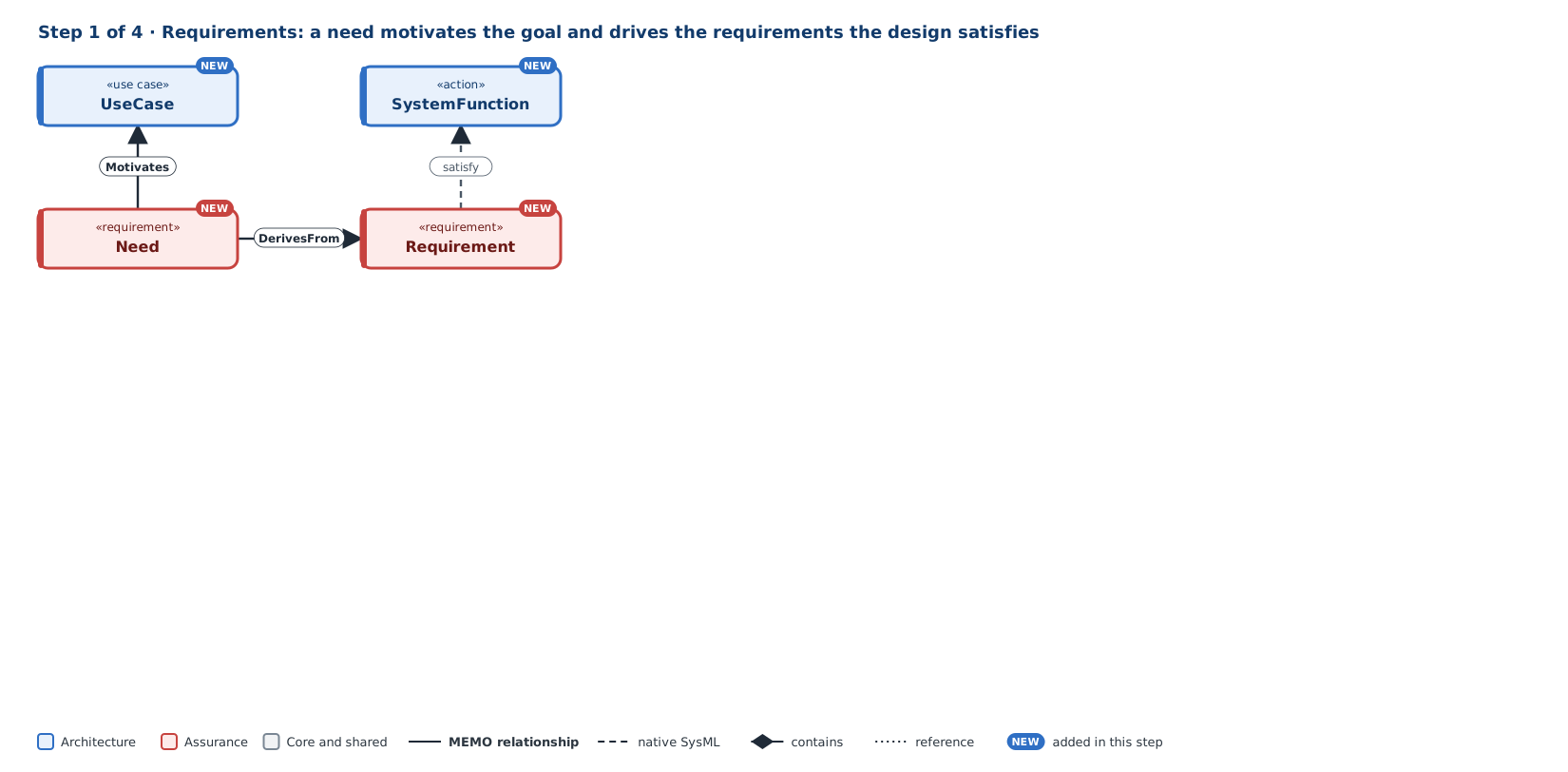
A Need motivates a use case (Motivates), and requirements derive from it
(DerivesFrom). The design meets a requirement with native satisfy.
Step 2 · Human factors and safety
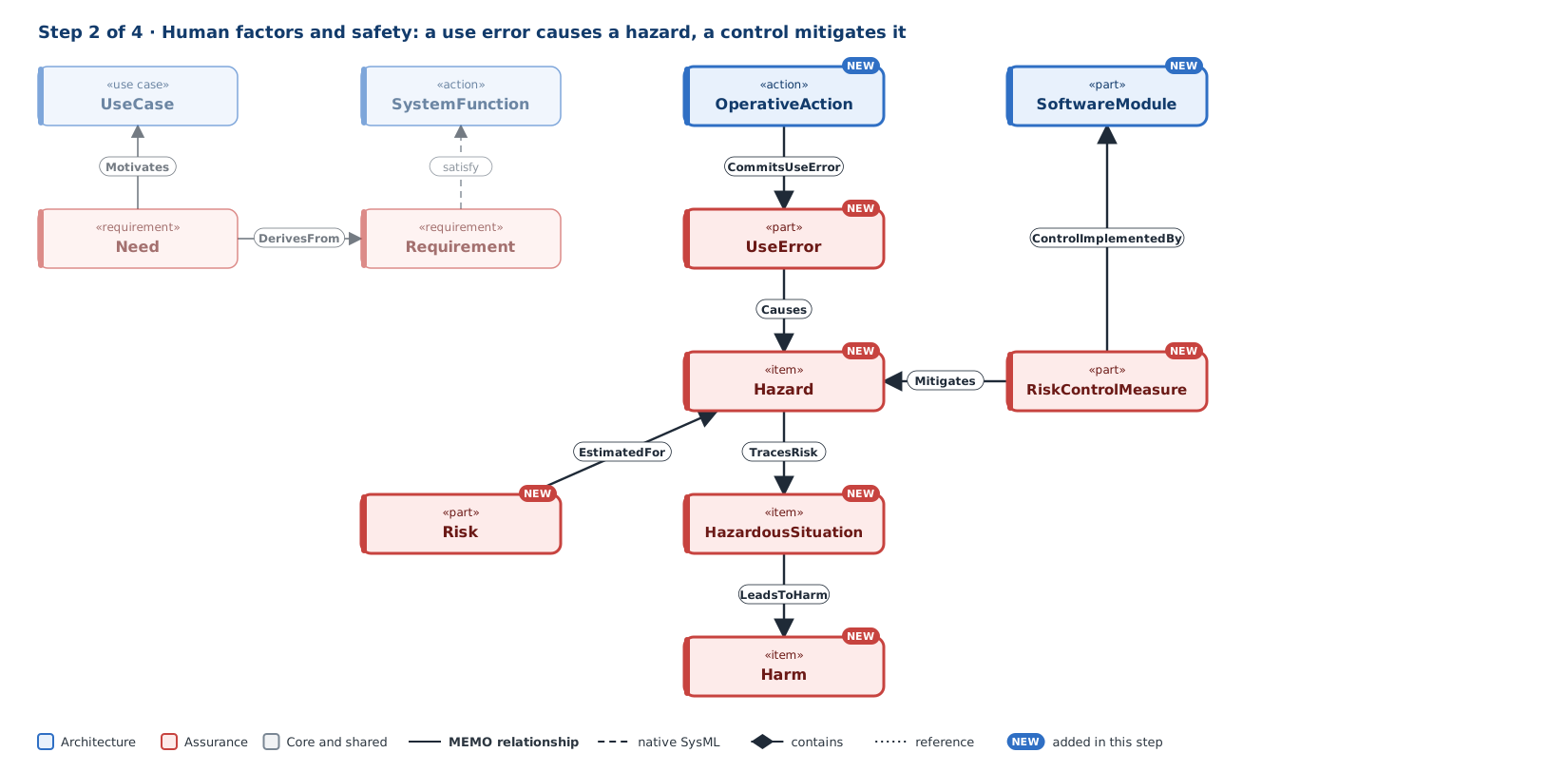
A task is where a UseError is committed (CommitsUseError), and a use error
can cause a Hazard (Causes). The hazard traces to a HazardousSituation
(TracesRisk), which leads to Harm (LeadsToHarm), the ISO 14971 chain. A
Risk is estimated for the hazard (EstimatedFor). A RiskControlMeasure
mitigates the hazard (Mitigates) and is implemented by a design element
(ControlImplementedBy), which is how the argument returns to the architecture.
Step 3 · Cybersecurity
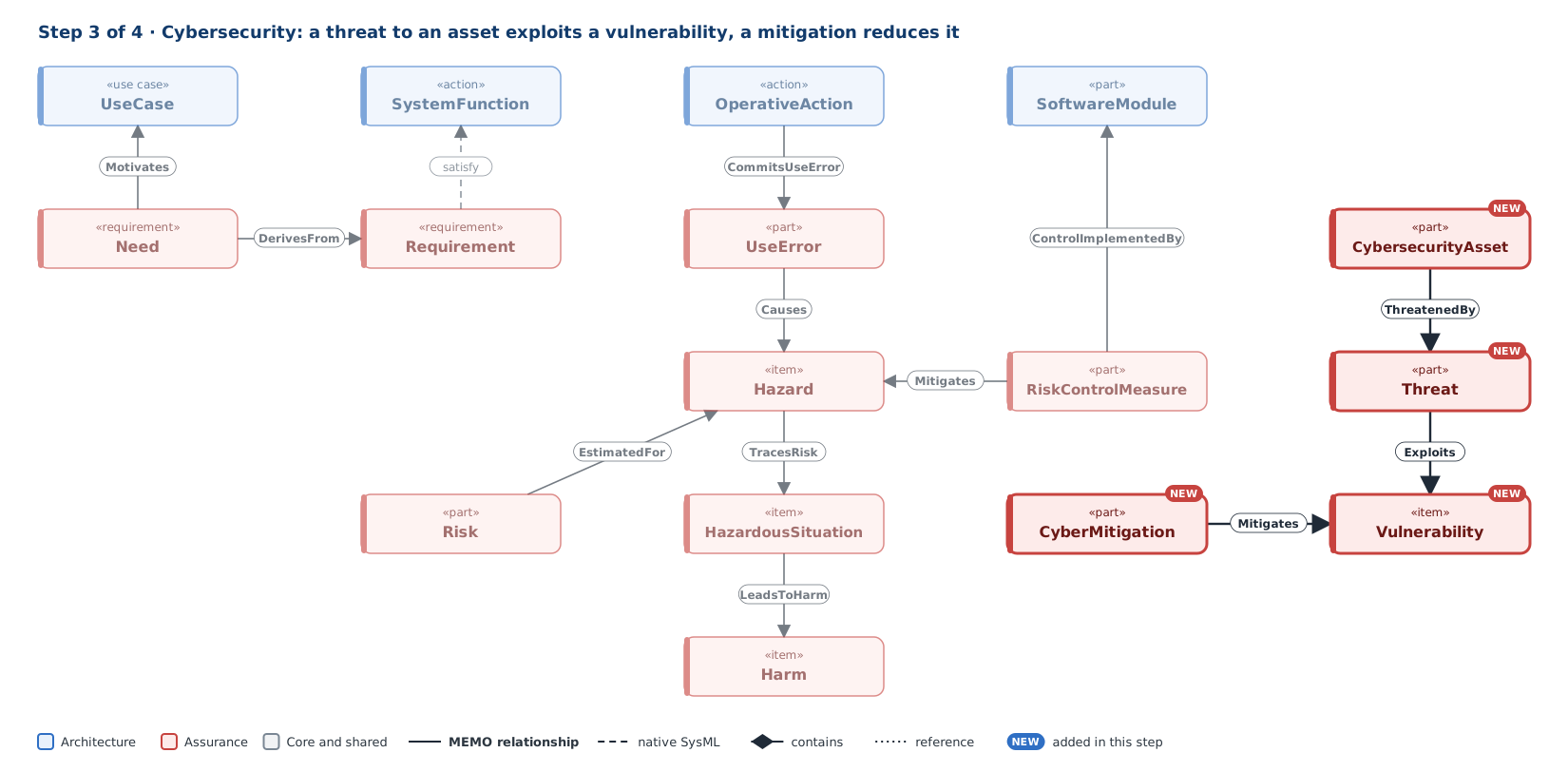
A CybersecurityAsset is threatened by a Threat (ThreatenedBy), which
exploits a Vulnerability (Exploits). A CyberMitigation is a risk control
measure, so it mitigates the vulnerability with the same Mitigates
relationship safety uses.
Step 4 · Verification and validation
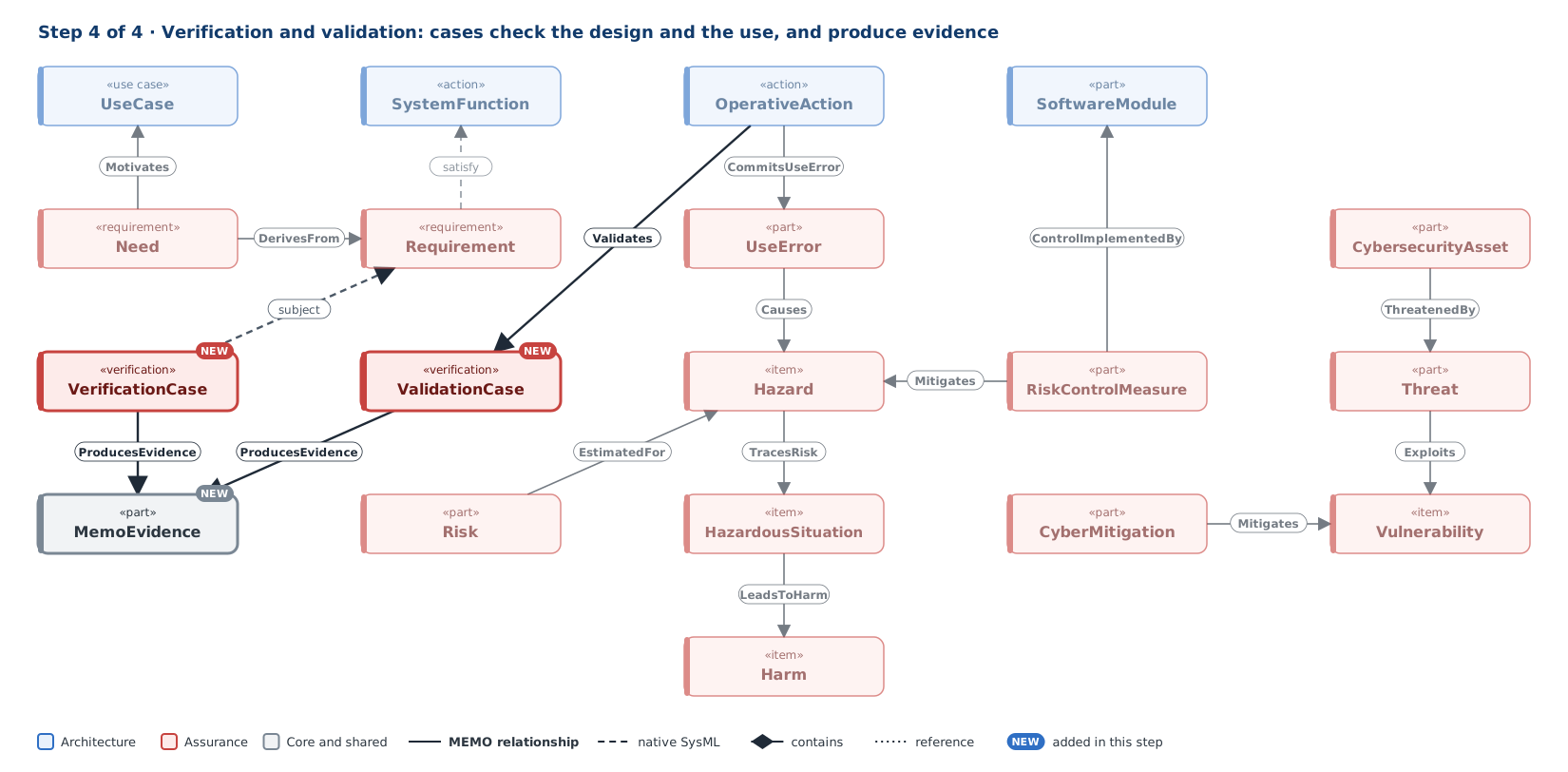
A VerificationCase names what it checks as its native subject: was the
system built right? A ValidationCase checks a use case or task (Validates):
was the right system built? Both produce MemoEvidence (ProducesEvidence),
the record a reviewer reads.
The disciplines
Each discipline owns its own elements and connects them to the architecture elements they are about. A hazard stays a hazard; a function stays a function. A relationship between them says how they meet.
| Discipline | The question it answers | Key elements |
|---|---|---|
| Requirements | What must be true, and why? | Need, Requirement, RiskDriver, SystemConstant |
| Safety and risk | What could cause harm, and what keeps the risk acceptable? | Hazard, HazardousSituation, Harm, Risk, RiskControlMeasure, FailureMode, FaultTree |
| Cybersecurity | What could an attacker do, and what stops them? | CybersecurityAsset, Threat, Vulnerability, CyberRisk, CyberMitigation, TrustBoundary |
| Human factors | Where can use go wrong? | UseError, and the tasks it is committed in |
| Verification and validation | How do we know it works, and that it is the right device? | VerificationCase, ValidationCase, TestStep, ClinicalEvaluation |
Why assurance uses MEMO's own relationships
The assurance disciplines mostly connect through MEMO's own relationships,
because they carry information the native forms do not. For example, Causes
records its kind of cause, and Validates keeps validation apart from
verification, as IEC 62304 does.
| MEMO relationship | Connects |
|---|---|
Motivates |
a need to the use case it motivates |
DerivesFrom |
a requirement to the need, hazard, threat or component it derives from |
CommitsUseError |
a task to a use error committed while performing it |
Causes |
a cause to its effect, such as a use error that leads to a hazard |
Mitigates |
a risk control to the hazard or vulnerability it reduces |
ControlImplementedBy |
a risk control to the design element that implements it |
Exploits, ThreatenedBy, ImpactsSafety |
threats to vulnerabilities, assets to threats, and security to safety |
Validates |
a use case, task or claim to the validation case that checks it |
ProducesEvidence |
a verification or validation case to the evidence it produced |