Architecture layers
The five architecture layers explain the device, from why it exists down to where its software runs. Each layer answers one question, and answers it without borrowing the answer of the layer below.
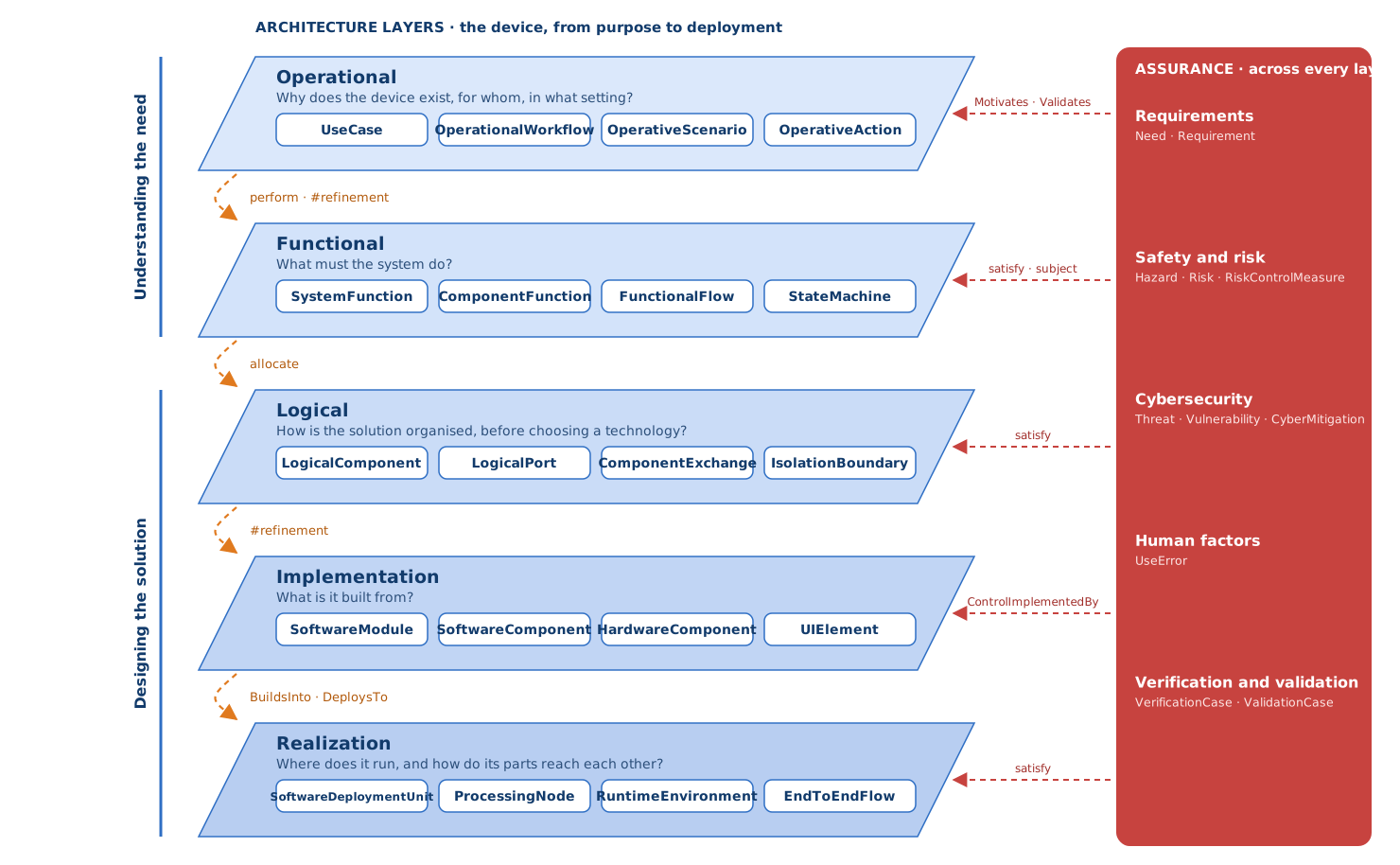
The first two layers are about understanding the need: the work the device enters and what the system must do in it. The last three are about designing the solution: how it is organised, what it is built from, and where it runs. The orange arrows name the relationship that carries the work from one layer to the next. Colours and line styles follow the key.
The layers
Each layer keeps to its own question. The operational layer never names the device's parts, and the functional layer never names a technology.
| Layer | The question it answers | Key elements |
|---|---|---|
| Operational | Why does the device exist, for whom, and in what setting? | UseCase, OperationalWorkflow, OperativeScenario, OperativeAction; supported by User, IntendedUse, UseContext |
| Functional | What must the system do? | SystemFunction, ComponentFunction, FunctionalFlow, FunctionalExchange, StateMachine |
| Logical | How is the solution organised, before choosing a technology? | LogicalComponent, LogicalPort, LogicalInterface, ComponentExchange, IsolationBoundary |
| Implementation | What is it built from? | SoftwareSystem, SoftwareModule, HardwareComponent, Sensor, UserInterface, UIElement |
| Realization | Where does it run, and how do its parts reach each other? | SoftwareDeploymentUnit, ProcessingNode, RuntimeEnvironment, EndToEndFlow |
A DesignDecision (in memo::architecture::decisions) records a choice that
affects elements in any of these layers.
How the layers connect
The native relationships do most of the connecting between architecture layers:
| Native SysML | Connects | Example |
|---|---|---|
actor, subject |
a user to the use case they pursue, and the system the use case is about | the ICU nurse initiates Monitor patient temperature |
perform |
an action to the function or scenario it carries out | a UI action performs Detect temperature deviation |
allocate |
a function to the component responsible for it | Detect temperature deviation is allocated to the monitor channel |
allocation … : BuildsInto, : DeploysTo, : HostedBy |
software to the image it builds into, the node it runs on, the board that hosts it | the firmware image deploys to the main controller |
#refinement dependency |
a realizing element to the element it realizes (the realizing one first) | the sensor input interface realizes the hardware-software bus interface |
satisfy |
a requirement to the design element that satisfies it | a software module satisfies a system requirement |
dependency |
an element that supports or uses another | the bedside display supports the acknowledgement task |
Each layer page lists every relationship that touches it, generated from the ontology source.