The layers
The layers are MEMO's conceptual model for moving from purpose to evidence. They organize engineering questions across a medical-device architecture.
Read the model along two axes:
- The architecture path moves from context and goals, through scenarios and functions, to logical organization and implementation.
- The assurance disciplines—requirements, safety, cybersecurity, human factors, verification, and evidence—connect across that path.
The first axis explains the device. The second asks whether the explanation is complete and supported.
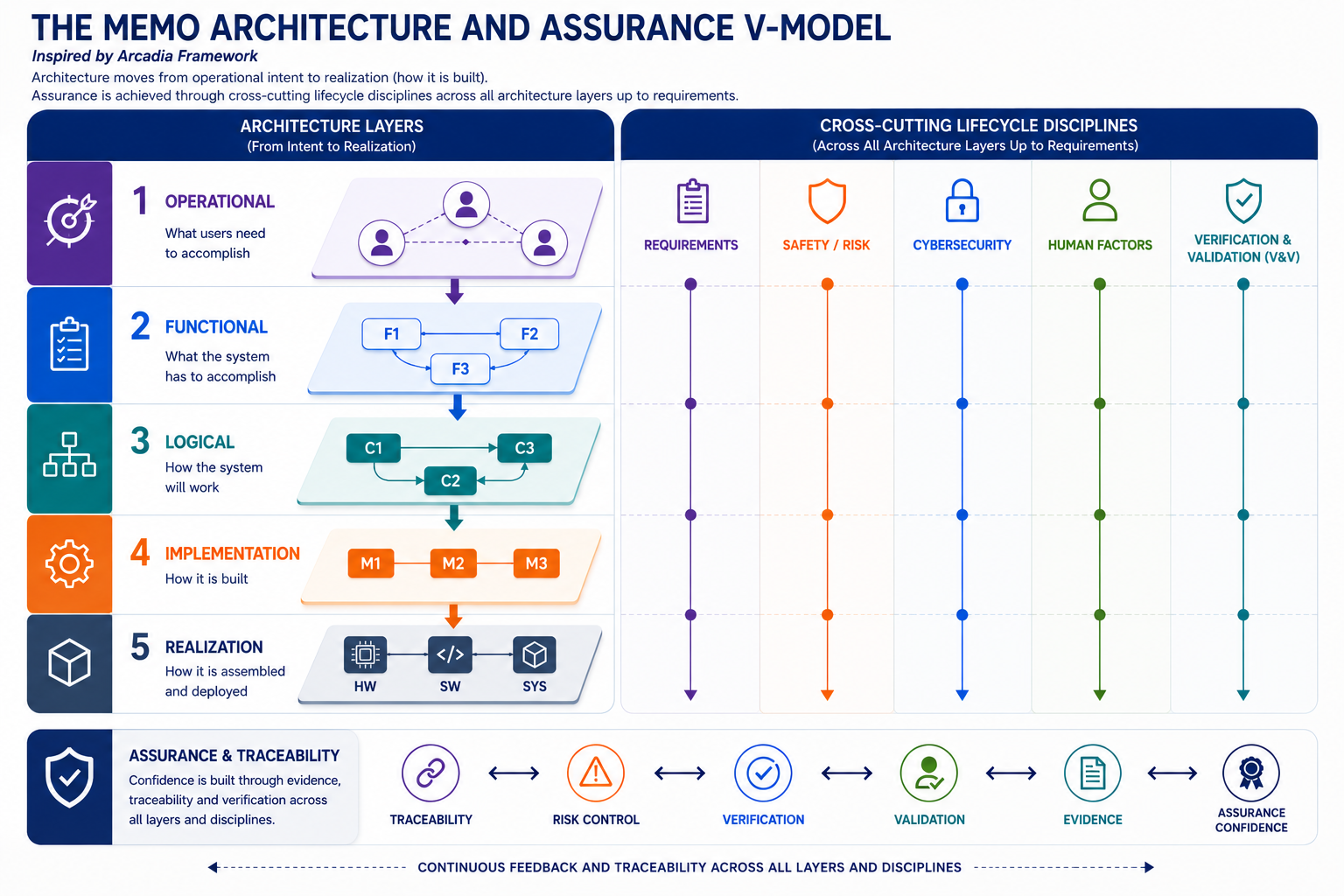
Each model element retains one identity. A function is an architecture element; a hazard is an assurance element. Typed relationships connect them across the two domains, allowing safety, cybersecurity, and verification views to refer to the same design element.
Read the V-model
Read each horizontal row before following either V. The operational row places stakeholder needs, intended use, users, use-related hazards, security context, and operational validation around operational concepts. The functional row contains functional and performance requirements, safety and cybersecurity controls, interaction requirements, and system V&V. The logical and implementation rows continue the same pattern. Each assurance discipline owns elements in every applicable architecture row and relates them to the architecture and V&V elements in that row.
The perspectives, layer by layer
Operational — why, for whom, in what context. The operational world exists before the device: stakeholders and their concerns, actors and users, needs, medical use cases (the user's goal), clinical procedures, workflows, scenarios, activities, and tasks. Modeling it first keeps the device honest about the work it claims to improve. → The Operational World
Functional — what the system must do. Technology-independent
responsibilities (SystemFunction), organized into FunctionalFlows with
typed exchanges. A later layer assigns each function to software, mechanics,
electronics, or a human procedure. → Functional Analysis
Logical — how the solution is organized. Still technology-independent: components, channels with safety roles (primary, redundant, monitor, interlock), data stores, control elements, ports, interfaces, modes, and isolation boundaries. Typed roles and independence constraints express redundancy while each component retains one identity. → Requirements and Architecture
Implementation — how it is realized. Software in three views (module, runtime, deployment), electronics, mechanics, fluidics, optics, and the rest of the physical taxonomy. This is where technology commitments live, and only here. → Requirements and Architecture
The disciplines
Requirements, safety, cybersecurity, human factors, and V&V run across the
layers. Each owns its own model elements. For example, a ValidationCase is a
V&V element that validates an operational use case or task (Validates). Likewise, a VerificationCase remains a V&V
element while checking a function or component. Requirements owns Need and
Requirement; safety/risk owns Hazard, Risk, and RiskControlMeasure;
cybersecurity owns CybersecurityAsset, Threat, Vulnerability, and its
controls; and human factors owns user tasks, UseError, and usability
evidence. A dose-limit checker can participate in safety, security, and
verification relationships through one model identity. Evidence and
traceability underpin all of it.
→ Risk, Cybersecurity, and Assurance
Follow scenarios into the appropriate realization
Every device model begins in the operational world. Context, use cases, workflows, and scenarios establish what people are trying to accomplish and the conditions under which the device participates. The functional layer then defines the system responsibilities required by those scenarios.
The technology-specific path begins when functions are allocated and realized.
A reusable forceps allocates functions to logical responsibilities and
mechanical elements (see manual-surgical-instrument). A software-only device
allocates them to logical components, software structure, runtime, and
deployment (software-only-medical-device). In both cases, safety-critical
functions trace to verification, critical tasks trace to usability validation,
and assurance evidence remains connected to the architecture it evaluates.
Use the map in a review
Start with the strongest available fact. A clinical scenario begins in the operational world; a change request begins at a requirement; an incident begins at an occurrence or a hazard. Then follow typed links in either direction until you can answer the review question.
Patient requests a bolus→Pump shall enforce a limit→Enforce-limits function→Independent monitor channel→Over-delivery test evidence
Review can begin from either direction. Risk can expose a missing requirement; verification can reveal a design ambiguity. The model keeps each discovery connected to its source and its consequence.
Continue the guide
Next, read Context and Use. It introduces the people, setting, and intended use before the workflow and scenario pages describe the work.