MEMO in a nutshell
MEMO describes a medical device as one SysML v2 model. That model holds what the device is for, what it does, how it is built, and the argument that it is safe and effective.
MEMO organises the model on two axes:
- The architecture layers explain the device. Each layer answers one question, from purpose down to deployed hardware.
- The assurance disciplines test that explanation. They run across every layer and ask whether it is complete and supported by evidence.
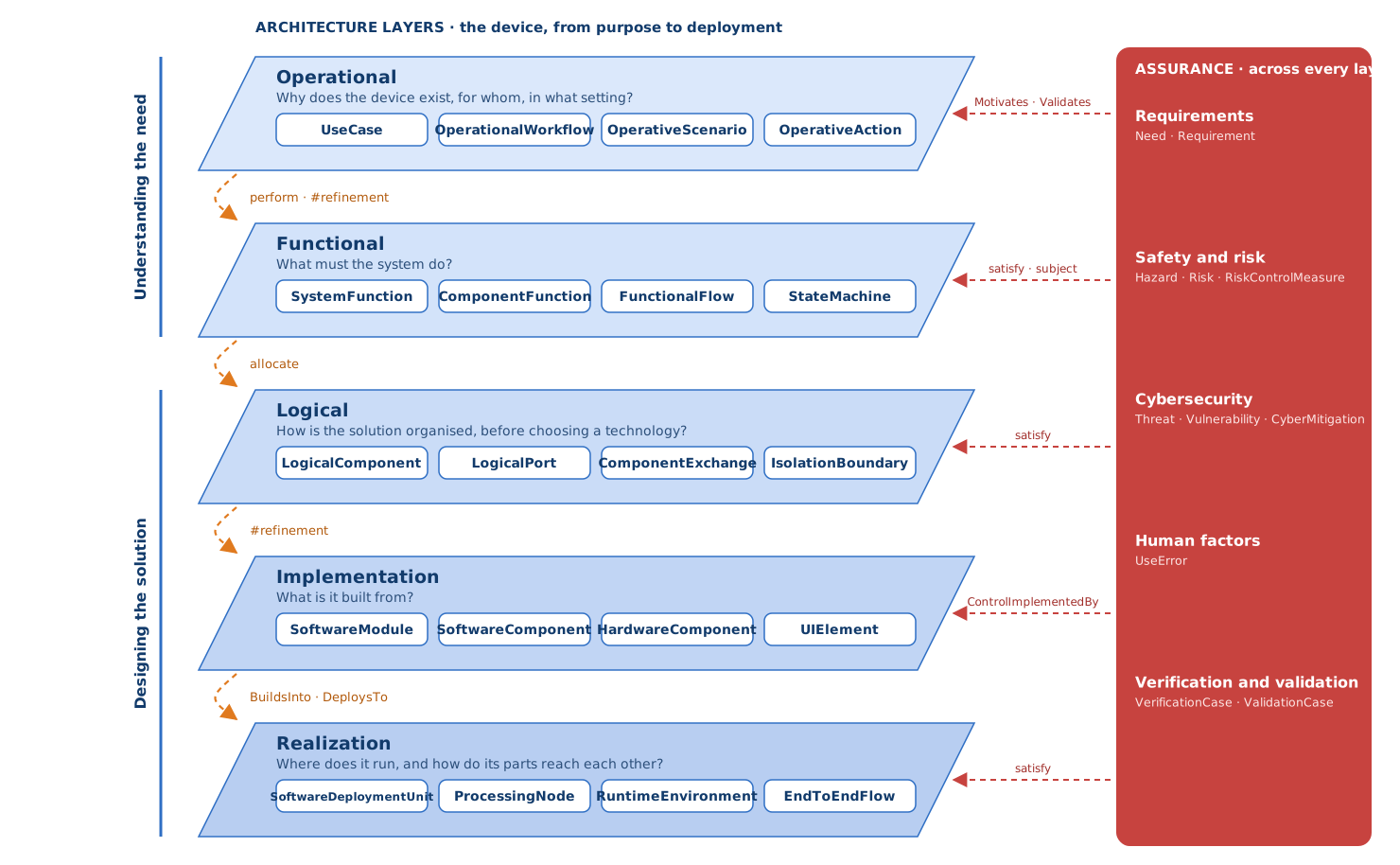
Read the picture top to bottom. Each blue plane is an architecture layer, with
the question it answers and its four core elements. The orange arrow between two
planes names the relationship that carries the work down: an operational action
performs a function, a function is allocated to a logical component, and so
on. The first two layers are about understanding the need; the last three
are about designing the solution. The red band on the right is assurance: each
discipline reaches into every layer, and the red dashed links name how.
How to read the figures
Every figure in these pages uses the same key.
| You see | It means |
|---|---|
| blue box | an architecture element: it explains the device (memo::architecture) |
| red box | an assurance element: it tests the explanation (memo::assurance) |
| green box | a methodology element: how the work is planned and run (memo::methodology) |
| grey box | a core element shared by everything (memo::core) |
| solid line, bold label | one of MEMO's own relationships, such as Motivates |
| dashed line, italic label | a native SysML v2 relationship, such as actor or allocate |
| line with a diamond | containment: the diamond end owns the other |
| dotted line | a reference feature, such as a scenario's useContext |
| bold box with NEW | in a step figure, what that step adds; faded boxes came earlier |
Each layer page opens with its whole picture and then builds it up in steps: first the layer's core, then the elements that support it.
The two axes
- Architecture layers explain the device: Operational,
Functional, Logical, Implementation, Realization. They connect mostly through
native SysML relationships such as
perform,allocateandsatisfy. - Assurance disciplines test that explanation: Requirements,
Safety and risk, Cybersecurity, Human factors, Verification and validation.
They connect mostly through MEMO's own relationships, such as
Causes,MitigatesandValidates, because those carry meaning a medical-device argument needs. - Foundations sit underneath both: Core, Artifacts, Viewpoints, Methodology, Rules.
One thread through every layer
The temperature alarm example is small enough to read in one sitting, yet it reaches every layer. Each layer page shows its part of the example.
flowchart TB
  nurse["ICU nurse<br/><small>User · operational</small>"]:::op
  uc["Monitor patient temperature<br/><small>UseCase · operational</small>"]:::op
  task["Acknowledge alarm<br/><small>OperativeAction · operational</small>"]:::op
  fn["Detect temperature deviation<br/><small>SystemFunction · functional</small>"]:::fn
  mon["Monitor channel<br/><small>LogicalComponent · logical</small>"]:::lg
  pri["Measurement channel<br/><small>LogicalComponent · logical</small>"]:::lg
  ack["Acknowledge<br/><small>UIAction · implementation</small>"]:::im
  banner["Alarm banner<br/><small>UIElement · implementation</small>"]:::im
  ue["Silence without assessment<br/><small>UseError · human factors</small>"]:::as
  hz["Undetected deviation<br/><small>Hazard · safety</small>"]:::as
  rc["Re-annunciation<br/><small>RiskControlMeasure · safety</small>"]:::as
  vc["Verify alarm latency<br/><small>VerificationCase · V&V</small>"]:::as
  val["Summative usability test<br/><small>ValidationCase · V&V</small>"]:::as
  ev["Evidence<br/><small>MemoEvidence</small>"]:::as
  nurse -->|actor| uc
  uc ~~~ task
  task -->|CommitsUseError| ue
  ue -->|Causes| hz
  rc -->|Mitigates| hz
  rc -->|ControlImplementedBy| banner
  banner -->|ElementTriggersAction| ack
  ack -->|perform| fn
  fn -->|allocate| mon
  mon -->|IndependentOf| pri
  vc -->|subject| fn
  task -->|Validates| val
  vc -->|ProducesEvidence| ev
  val -->|ProducesEvidence| ev
  classDef op fill:#e8f1fc,stroke:#2f6fc4,color:#1f2a44
  classDef fn fill:#e8f1fc,stroke:#2f6fc4,color:#1f2a44
  classDef lg fill:#e8f1fc,stroke:#2f6fc4,color:#1f2a44
  classDef im fill:#e8f1fc,stroke:#2f6fc4,color:#1f2a44
  classDef as fill:#fdebea,stroke:#c7433f,color:#1f2a44
Read the thread as one argument. The nurse must notice a deviation. The system detects it on a monitor channel that is independent of the measurement channel. The banner announces it. If the nurse silences it without assessing it, the deviation can go undetected. The re-annunciation control, implemented by the banner, reduces that hazard. A verification case and a usability validation produce the evidence for both.
Where to go next
- Read one layer page: each opens with its question and its whole picture, builds the picture up step by step, and keeps the full inventory folded away.
- Choose an element and write a relationship when you model.
- Browse the generated API for every definition.